The 2026 FIFA Men’s World Cup was supposed to be soccer’s big breakthrough in the United States. Instead, it’s turning into a masterclass in how to alienate a new audience. Wednesday night’s Round of 32 clash between the U.S. and Bosnia delivered a moment that has American sports fans—both casual and hardcore—shouting at their screens in disbelief.
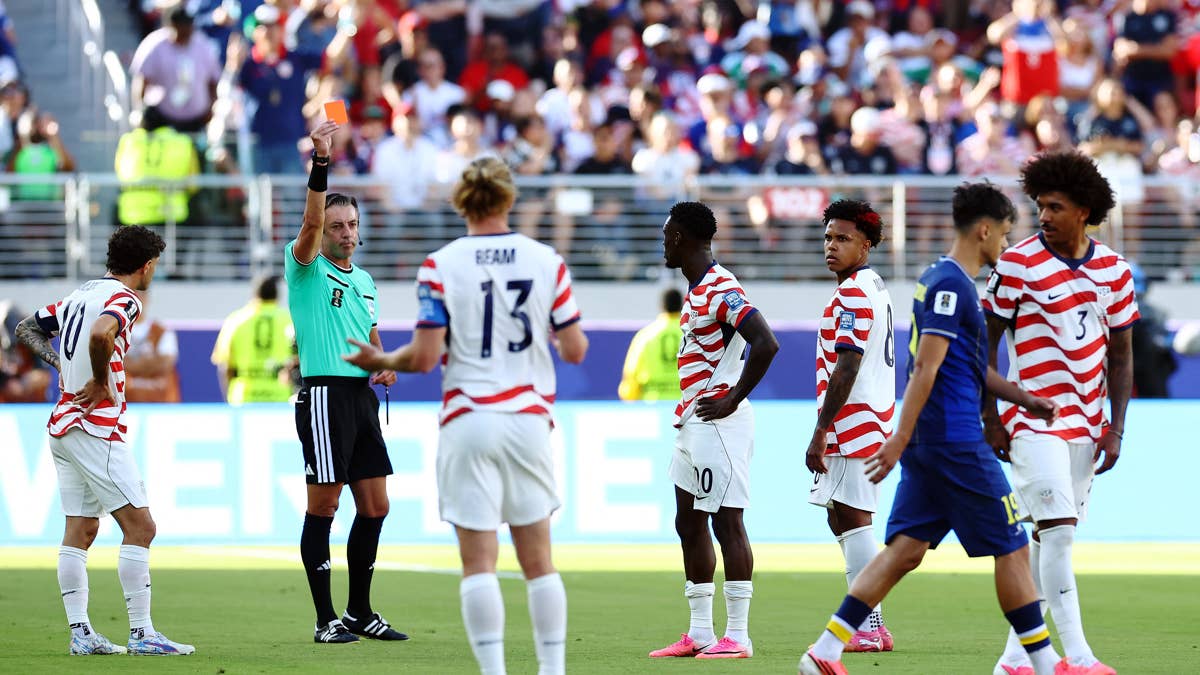
It happened in the second half. U.S. forward Folarin Balogun went for a 50-50 ball, his foot accidentally grazing the calf of a Bosnia defender. It was a routine tangle, the kind you see a dozen times in any NFL game without a second thought. But soccer’s rulebook isn’t built for common sense. After a VAR review, the referee pulled out a red card, ejecting Balogun and suspending him for the next match if the U.S. advances.
The reaction was swift and brutal. Social media lit up with frustration from fans who just can’t wrap their heads around a system that punishes an incidental collision as if it were a deliberate assault. One fan posted, “Soccer will never be popular in America. What we’re seeing with the World Cup is a fad. Within months we will be addicted to the NFL again.” Another added, “Official just ended soccer in the United States. This is why this country loathes this sport and always will.”
Even top athletes are baffled. Philadelphia Eagles star Jason Kelce tweeted, “Man, somebody help me. That foul looked incidental from Balogun, shouldn’t a Red Card be given if there is either intention to foul, or an action that is aggressive and unsafe in nature?” New York Knicks guard Josh Hart simply asked, “Bro that’s a red card?!” The confusion is universal—and it’s a massive red flag for a sport trying to win over a nation that prizes clarity and consistency in officiating.
This isn’t just about one bad call. It’s about a pattern that makes soccer feel like a foreign language to American eyes. In the NFL, a questionable pass interference flag might draw groans, but you rarely see a player tossed from the game for a borderline play. In the NBA, a hard foul might earn a technical, not an automatic ejection and a suspension. Soccer’s rigid, zero-tolerance approach to anything that looks remotely dangerous—even when it’s clearly accidental—feels like a relic from an era before replay and common sense.
The irony is that the World Cup has been a massive success in the U.S., drawing huge crowds and TV ratings. But moments like this threaten to undo that goodwill. As one fan joked, “Soccer, the sport of the 80’s…Do you know why kids play soccer? So they don’t have to watch it.” That cynical take has found new life thanks to a red card that felt more like a robbery than justice.
Some critics are calling for a complete overhaul of soccer’s disciplinary rules, similar to the wild rule changes proposed by Dave Portnoy that would make purists cringe. Others point out that American sports have their own officiating headaches—just look at the controversy in college football over inconsistent rulings. But the difference is that in those sports, the outrage is usually about a missed call, not a rule that seems designed to punish players for playing hard.
For now, the U.S. team must regroup without its top scorer, and fans are left wondering if soccer will ever truly click with the American sports psyche. The passion is there—the World Cup crowds prove that. But the rules? They’re a wall that keeps getting higher. If soccer wants to win over U.S. fans, it needs to start listening to what they’re saying: enough with the red card madness.