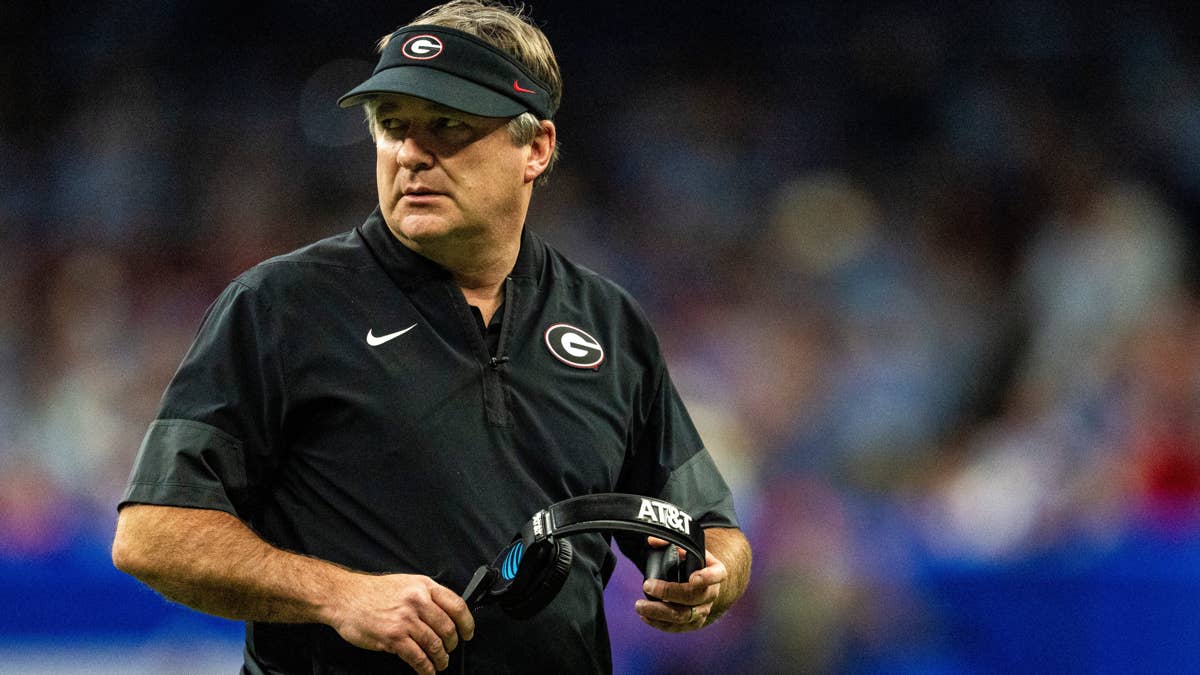
For years, the SEC was the undisputed king of college football. But after three straight national titles went to the Big Ten, Georgia head coach Kirby Smart has a theory on why the tide has turned.
In a recent interview on “The Next Round,” Smart didn’t hold back. He pointed straight at the Big Ten’s rising depth—something that was once the SEC’s trademark. “I just think they have a more competitive conference,” Smart said. “At the top of their conference, there’s more good teams. It used to be Ohio State was good. Well, Michigan was really good with Harbaugh, had a great team. Indiana’s good. Like, now they’ve got Oregon. They’ve got a draw. They have the ability to attract good players.”
That ability to recruit isn’t what it used to be in the SEC. Smart didn’t shy away from the elephant in the room: NIL money. He argued that the financial playing field has leveled dramatically, spreading talent across the country instead of funneling it into the South.
“Now NIL has a factor too, for sure, but so does Miami. So does Florida. I mean, people have money. More people have money,” Smart explained. “So I think the talent is spread out thin, whereas before in the SEC, it was a magnet to talent. The disparity was so great that it was like you couldn’t mess it up. You’d win regardless. And now it’s like, OK. It’s more even. And it’s just been three in a row, they did it.”
That three-year drought is a stark contrast to the SEC’s dominance from 2006 to 2020, when it won 13 of 15 titles. Smart isn’t using NIL as a crutch, though. He’s also pointing to another factor: the brutal grind of SEC play. According to Smart, the conference’s bottom-tier teams are far tougher than their Big Ten counterparts, and that wears down contenders late in the season.
“A lot of SEC coaches say this in my meetings, they say, ‘They don’t have the grind we do. There’s no way. They play three of their nine games are hard. Their bottom four games are not our bottom four games. I’m going to play at Starkville and Vanderbilt in my bottom four and I’m holding onto my butt to be able to play at noon on Saturday in Starkville, who beat Arizona State, who goes and plays these other teams.’ So there is a theory that we’re beating each other up and it’s like the intensity and it wears you down.”
Smart’s comments echo a broader conversation about college football’s transformation. Nick Saban has also slammed the financial “unfairness” of the sport, calling for a salary cap. Meanwhile, Paul Finebaum has warned that the gambling crisis is just getting started—another layer of change reshaping the landscape.
Despite the SEC’s recent slide, Smart believes the conference can bounce back. Georgia is poised to contend again next season, especially if quarterback Gunner Stockton continues to develop. With Smart’s trademark defense, the Bulldogs will be a threat. Texas, led by Arch Manning, should also be in the top 10 all year. And don’t count out Alabama, LSU, Ole Miss, or Texas A&M—all potential playoff teams.
For now, though, the Big Ten holds the crown. Smart’s theory offers a clear-eyed look at why—and a roadmap for the SEC to reclaim its throne.