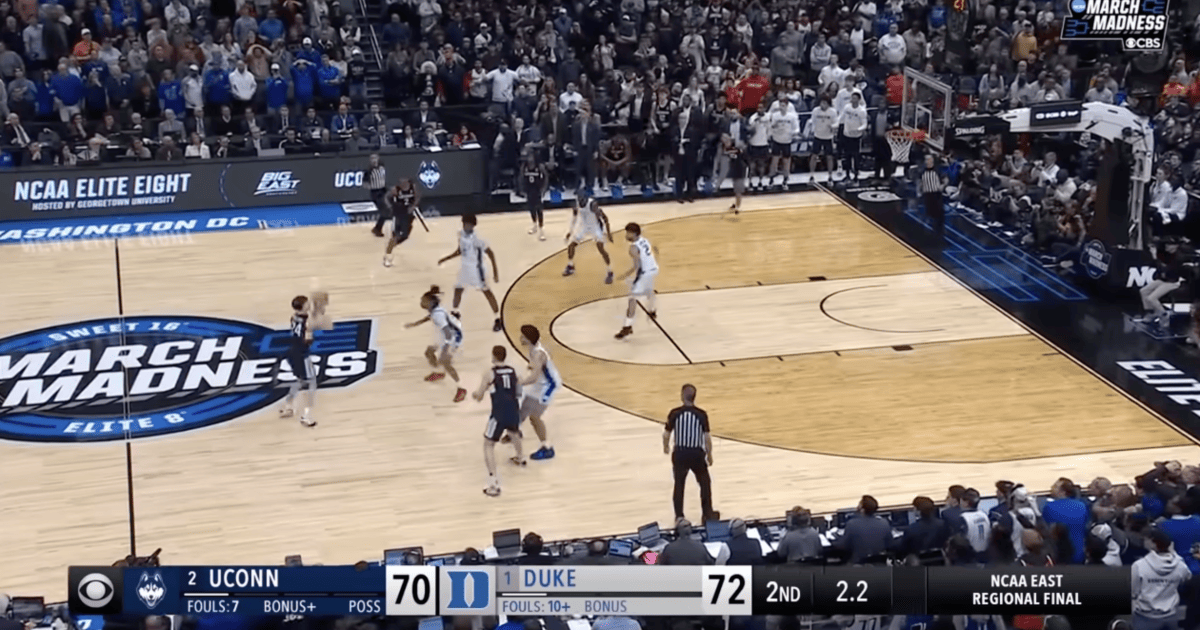
March Madness delivered another heart-stopping classic Sunday night, but the aftermath of UConn's 73-72 victory over Duke has been dominated by one fiery question: did the officials swallow their whistles when it mattered most?
The Huskies are Final Four-bound after freshman sensation Braylon Mullins drained a cold-blooded three-pointer in the final seconds, capping a stunning sequence that began with a critical Cayden Boozer turnover. Yet, the celebration was instantly marred by a moment of pure chaos on the sideline.
As the shot dropped through the net, an ecstatic UConn head coach Dan Hurley rushed onto the floor and made clear, undeniable contact with an official. The incident, captured from multiple angles, showed what many are calling a soft head-butt in the heat of the moment. With precious seconds still ticking, the pivotal question emerged: should this have been an automatic technical foul?
A Technical Foul That Never Came
In the rulebook, making intentional contact with an official is typically a cut-and-dried violation, often resulting in a technical foul and potential ejection. Had a whistle blown, Duke would have been awarded free throws with a chance to tie or win the game, potentially rewriting the ending entirely.
The silence from the officiating crew has sparked outrage. Critics argue that consistency demands a call, regardless of the moment's emotion or the game's magnitude. This controversy adds fuel to an already fiery debate about officiating in high-stakes tournament games, where every decision is magnified.
Sam Dekker Sounds Off
Leading the charge is former Wisconsin star and NCAA tournament hero Sam Dekker. Never one to mince words, Dekker took to social media to blast the non-call. "I have no bias here. This is a tech 10/10 times," Dekker stated emphatically.
He elaborated, pointing to the precedent it sets: "For multiple reasons… it would have lost the game for his team and he would have tried to fight the officials like he did nothing wrong. I just don't understand it at all. Also, referees need to grow a spine in instances like this."
Dekker, whose Badgers fell to Duke in the 2015 national championship game, even preemptively dismissed any claims of anti-Duke bias with a characteristically sharp retort: "Brother I LOST to Duke in the national championship. Do you think I'm sad THEY lost?!"
The incident overshadows what was a brilliantly played Elite Eight battle. Duke's season ends in agonizing fashion, while UConn's magical run continues, though now with a significant asterisk in the eyes of many. The play also continues a trend of controversial calls involving key players like Cayden Boozer in critical moments.
The Human Element vs. The Rulebook
Defenders of the no-call point to the human element of the game. Hurley, known for his passionate and volatile sideline demeanor, was undoubtedly overcome by the seismic moment—a game-winning shot to send his team to the Final Four. To assess a technical in that split second of unbridled joy could be seen as excessively rigid, punishing raw emotion in the sport's most pressure-packed setting.
However, this argument clashes directly with the principle of consistent rule enforcement. If contact is an automatic technical in the first minute of a November non-conference game, why not with a Final Four berth on the line? The inconsistency is what fuels the frustration for Duke fans and neutral observers alike. This debate echoes the immediate outcry from the Duke radio crew who witnessed the contact in real time.
As UConn prepares for the national semifinals, the controversy ensures their journey will be scrutinized. For Dan Hurley, it's another chapter in his intense coaching narrative. For the NCAA and its officials, it's another moment under the microscope, a decision that will be debated long after the nets are cut down in Phoenix.
The final buzzer may have sounded in Washington D.C., but the argument over this game's true ending is just getting started. One thing is certain: in the cauldron of March, where legacies are forged and broken, the line between celebratory instinct and punishable offense has never looked thinner.